
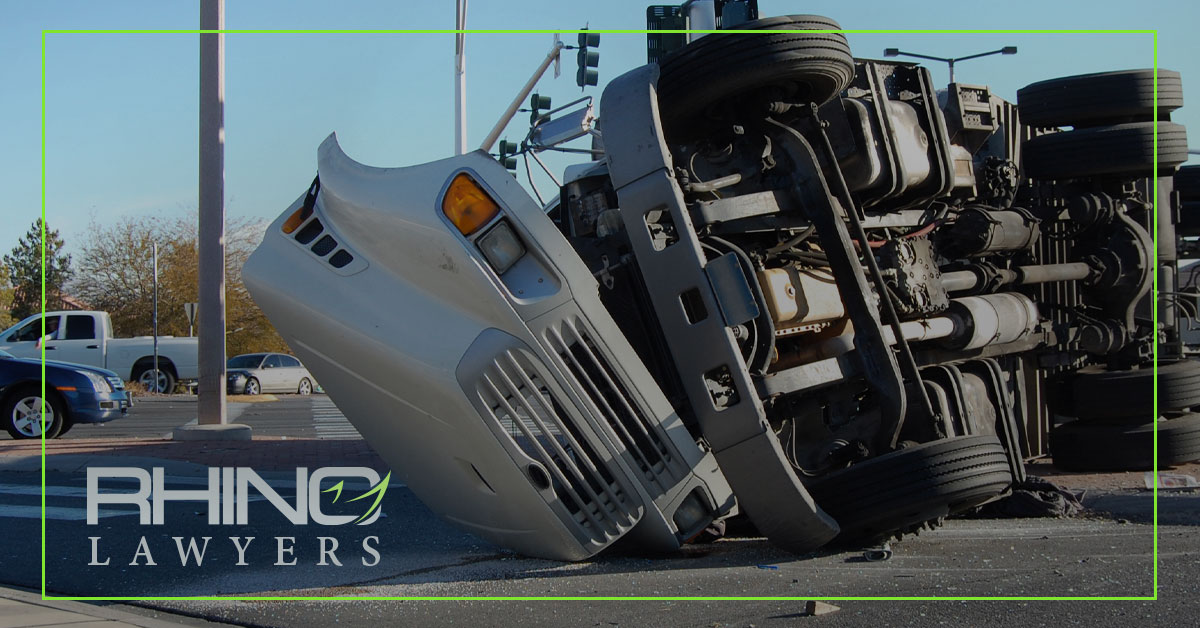
TRUCK ROLLOVER ACCIDENT
Large truck rollover accidents are the worst kind of truck accidents. Considering, for these accidents to occur the large truck must flip over while moving. Unfortunately, this type of accident is all too common on the roadways.
In fact, large trucks are prone to rollover accidents. This is due to their high center of gravity making them top-heavy. But these accidents are preventable. Knowing the common causes will help you to be proactive and decrease the amount of truck rollover accidents.
Common Causes of Trucking Rollovers
Incidentally, truck rollover accidents can occur because of many factors. According to the Federal Motor Carrier Safety Administration (FMCSA), over 78% of them involve driver error. However, driver error is not the only cause. Some of the common causes of truck rollovers include:
- Speeding – Higher speeds while turning or going around a curve could cause the trailer load to shift. This gives the truck more potential for a rollover accident.
- Careless/Reckless Driving – This includes drivers who are sleep-deprived, under the influence, and inexperienced with driving large trucks.
- Improperly Loaded Trailer – Causes rollovers when the shifts in transit. Commonly, due to not properly securing the cargo or unevenly distributing the weight of the cargo.
- Wind – Large truck trailers are tall and long making them susceptible to high winds. Drivers should avoid driving during high wind advisories.
- Improper Maintenance – Not maintaining the proper tire pressure and damage to the suspension can cause the truck to tip. Especially, when driving around sharp curves, uneven road surfaces, and steep downhill grades.
TIPS to Avoid a Trucking Rollover Accident
Even though, you cannot prevent truck driver error or weather conditions. While sharing the roads and highways with large trucks you can take precautions to avoid a rollover crash with a large truck.
- Drive Slower – When driving do not zip around or try to get the truck driver to drive faster. The higher speeds can contribute to many different accidents including rollovers. So, slow down and try to be patient. Even if it means you add a few minutes to your drive.
- Avoid Truck Blind Spots – Remember in order for the truck driver to see you, you must be visible in the truck’s mirror. Staying out of the blind spot can prevent the truck driver from trying to change lanes into you or an overreaction when the driver notices you in the lane. Keeping you, the truck driver, and other motorists safer.
- Don’t Pass Next to a Sharp Drop – Always focus on passing safely. Avoid passing on the side a steep drop and make sure you stay in your lane.
- Allow Truck Drivers Room to Turn – When a driver truck does not have enough room to turn it increases factors that can lead to rollover accidents. So, don’t follow too closely and allow plenty of room for them to turn.
- Pay Attention to Truck Cargo – While you can’t see the cargo in an enclosed trailer, you can see cargo on a flatbed. They secured cargo on flatbeds with straps. Unfortunately, the straps can loosen during the drive causing the cargo to shift. If you notice the cargo moving around don’t drive beside the truck. Try to signal the driver to make them aware of the issue.
CONTACT A TAMPA ATTORNEY
After a trucking accident, you may not know your rights. Don’t struggle through the process alone. Our personal injury team is here to help you with any legal needs you might have regarding your accident.
Let RHINO Lawyers answer your questions and review the facts of your case with a Free Consultation. Get started by completing the “Free Instant Case Evaluation” or by calling us any time, day or night, at 844.329.3491.
Read More
AUTO ACCIDENT NECK INJURY
Neck injuries are the most common injuries from auto accidents. Though an auto accident can affect your entire body, your neck is the most vulnerable. This is mostly due to the anatomy of the neck.
In fact, only the top seven vertebrae of the spin are part of the neck or cervical spine. These bones are small and thin. In addition, to bones, the neck has blood vessels, discs, and soft tissues like muscles, tendons, and nerves.
Consequently, thin bones and limited muscle support makes the neck susceptible to injury. Especially, from sudden movements.
Common Neck Injuries
If you injure your neck in a car accident you could feel the pain in other body parts. This could result from the part of the neck you injured in the accident. Here are the most common injuries to the neck:
- Muscle Spasms – Happen when muscles involuntary contract causing tightness and pain around the vertebrae.
- Lacerations or Abrasions – Also known as open wounds. These can cause infection, damage to tendons, or ligaments.
- Whiplash – Typically, occurs when the head is thrust back-and-forth suddenly.
- Soft Tissue Damage – Involves injuries to the muscles, tendons, or ligaments instead of the cervical spine.
- Vocal Cord Damage – An impact from a car accident could affect your larynx causing one or both of your vocal cords to not open properly.
- Brain Injuries – Caused when a neck injury damages the arteries. An injured artery could restrict the blood flow to your brain resulting in brain injury.
- Paresthesia – Is the pressure on the nerve from a slipped disc. As a result, it gives a prickling, burning, tingling, numb feeling (pins and needles feeling).
Consequently, it is possible to sustain more than one of these injuries in an auto accident. Therefore, it is important to have your injuries checked by a medical professional after an accident.
Long-Term Injury SYMPTOMS
Injuring your neck in a car accident is painful and can affect how you function in your daily life. However, left untreated the injury could escalate to a chronic health condition affecting your mental and emotional health. Here are some symptoms of long-term injuries to your neck.
|
|
|
|
|
|
|
|
|
|
|
|
|
|
|
|
CONTACT A TAMPA AUTO ACCIDENT ATTORNEY
After a car accident, you may not know your rights. Don’t struggle through the process alone. Our personal injury team is here to help you with any legal needs you might have regarding your accident.
Let RHINO Lawyers answer your questions and review the facts of your case with a Free Consultation. Get started by completing the “Free Instant Case Evaluation” or by calling us any time, day or night, at 844.329.3491.
Read More
MOTORCYCLE INSURANCE
Check your motorcycle insurance before riding this spring. With perfect riding weather on the way if you own a motorcycle you’ll want to ride. Incidentally, even a skilled motorcycle rider can succumb to the dangers of the road.
For a motorcyclist, road dangers are more than potholes, loose sand, and gravel. Additionally, they must contend with the actions of other motorists. Let alone, whether they have insurance or sufficient motorcycle coverage. Thus, checking your insurance policy is important.
Florida And Motorcycle Insurance
Florida motorcycle insurance laws baffle and mislead some people. Under the Florida no-fault law motorcycles are not considered motor vehicles. Because of this, motorcyclists are not required to carry Personal Injury Protection (PIP) or Bodily Injury (BI) coverage.
However, Florida does require riders to wear helmets. Unless the rider is over the age of 21. Then they must have a Financial Responsibility Certificate, $10,000 in medical insurance, or liability insurance.
coverage options for Motorcyclists
Although, these are optional for motorcyclists. Having them would help protect you after a motorcycle accident. Considering, a night in the hospital could run well over $25,000. You don’t want to rely on the other motorist.
In some cases, an uninsured or underinsured driver is at-fault for the accident. That’s when your policy might pay for losses and injuries. Consider these standard insurance options.
- Collision – This coverage will pay for damages to your motorcycle.
- Comprehensive Coverage – will pay for damages to your motorcycle caused by something other than an accident. It will also pay for stolen bikes.
- MedPay – This is a provision that drivers can get on their own policy. It will pay for medical bills regardless of who is at fault or injured. So long as the accident involved the insured or their vehicle.
- Personal Injury Protection (PIP) – This works like MedPay. But it pays medical bills and other damages like pain and suffering and loss of wages. It also pays out regardless of the injured party or at-fault. So long as the accident involved the insured or their vehicle. Motorcycle PIP is not regulated by Florida law so you will need to review all terms of the contract.
- Uninsured/Underinsured (UM/UIM) – Most insurance policies have uninsured/underinsured provisions. These will cover all your personal injury damages from underinsured or uninsured drivers. Motorcyclists should stack UM coverage on their auto insurance. Because it will always cover injuries sustained while riding a motorcycle.
In Florida, the law doesn’t require that a driver have UM/UIM. Yet, many people carry that as protection against those with no or little insurance. If a driver has any of these provisions, then they can collect against their own insurance company for their losses.
CONTACT A TAMPA MOTORCYCLE ACCIDENT ATTORNEY
After a motorcycle accident, you may not know your rights. Don’t struggle through the process alone. Our personal injury team is here to help you with any legal needs you might have regarding your accident.
Let RHINO Lawyers answer your questions and review the facts of your case with a Free Consultation. Get started by completing the “Free Instant Case Evaluation” or by calling us any time, day or night, at 844.329.3491.
Read More
MOTORCYCLE SAFETY TIPS FOR SPRING
Think motorcycle safety this spring. Although motorcyclists can ride throughout the year in Florida, we still get an increase of motorcycles on the road in the spring. This is due to the beautiful weather and the influx of people visiting the state.
With so many people riding motorcycles the risk of accidents rises. In fact, the National Safety Council states 14% of all traffic deaths are motorcyclists. Consequently, this makes sense due to motorcyclists being less visible to other motorists and not having a steal chaise protecting them.
Yet, we can all help improve the safety of motorcyclists this spring by following some basic safety rules.
Tips for The Motorcyclist
The National Highway Traffic Safety Administration (NHTSA) and the Motorcycle Safety Foundation (MSF) recommend these safety tips:
- Safety Course – Whether your state requires a course or not to receive your license take it. Because all motorcyclists can benefit from a motorcycle safety course. At any rate, they will teach you important motorcycle traffic laws and how to handle emergencies.
- Wear a helmet – Considering, the leading cause of death in a motorcycle accident comes from head injuries. Wearing a DOT-approved helmet is one of the best ways to protect your head while riding.
- Other protective gear – Protecting your head is not the only thing you should worry about protecting. A motorcyclist should always wear protective clothing like a jacket, pants, gloves, and sturdy shoes. Wearing bright colors or clothing with reflective strips will also help improve your visibility to other motorists.
- Pre-ride maintenance check – Before you ride always give your motorcycle a once over. Check for fluid leaks, fluid levels, tire pressure, all lights, chain, and brakes.
- Road Awareness – As a motorcyclist, you should pay close attention to road conditions. Slippery roads can be very dangerous for motorcycle riders. Try to anticipate the actions of other drivers and watch for road hazards like potholes and loose sand.
Safety Tips for MOTORISTS
Motorcycle safety does not start and end with the motorcyclist. By the same token, all motorists can take precautions while sharing the road with motorcyclists. These safety tips could help keep our roads safe.
- Watch the road – Motorcycles are small and easily overlooked. Therefore, you should avoid distracted driving. Put your cell phone down so you are not talking or texting while driving. Because taking your hands and eyes off the road puts you at risk of an accident.
- Keep safe distance – It is important to always keep a safe distance between you and a motorcyclist on the road. Incidentally, motorcycle riders occasionally need to slow their speed or move within the lane to avoid hazards on the road. Maintaining a safe distance will help avert a rear-end collision with a motorcyclist.
- Yielding – Treat motorcycles the same as other vehicles on the road and yield to approaching motorcycles. Many motorcycle accidents occur when a car turns in front of them.
- Blindspot awareness – First of all, all cars have blind spots. Remembering to check your mirrors and look over your shoulder before changing lanes. It could be the difference between you hitting or not hitting a biker.
CONTACT A TAMPA MOTORCYCLE ACCIDENT ATTORNEY
After a motorcycle accident, you may not know your rights. Don’t struggle through the process alone. Our personal injury team is here to help you with any legal needs you might have regarding your accident.
Let RHINO Lawyers answer your questions and review the facts of your case with a Free Consultation. Get started by completing the “Free Instant Case Evaluation” or by calling us any time, day or night, at 844.329.3491.
Read More
HOW LONG DO POINTS LAST ON YOUR LICENSE
Have you ever wondered how long the points stay on your license? To start with, you accumulate points on your license due to traffic violations. Unfortunately, these points will always remain on your record.
However, the points only count against you for three years. Incidentally, these will continue to collect on your license so the state can track and enforce penalties. Because you could have your license suspended if you accumulate too many points.
Points From Traffic Violations
Considering, you receive points on your license from traffic violations. It is important to know and understand the common traffic violations. It will help you to avoid getting points on your license. Florida’s common traffic violations include:
| VIOLATION | POINTS |
| Moving violations (non-speeding, no accident) | 3 Points |
| Speeding up to 15 mph over the posted speed | 3 Points |
| Littering | 3 Points |
| Violation of child restraint laws | 3 Points |
| Driving with an open container in your vehicle | 3 Points |
| Speeding more than 15 mph over the posted speed | 4 Points |
| Passing a stopped school bus | 4 Points |
| Moving violation (non-speeding) resulting in a crash | 4 Points |
| Reckless driving (criminal traffic violation) | 4 Points |
| Illegally passing a stopped school bus | 4 Points |
| Unlawful speed resulting in a crash | 6 Points |
| Leaving scene of crash with damage greater than $50 | 6 Points |
Long-Term Consequences From Points
Receiving points on your license result in long-term consequences. In fact, your insurance rates will increase for at least three years after a citation. Not to mention, too many points over time will result in a suspension of your driving privileges.
| POINTS | SUSPENSION |
| 12 points within 12 months | 30-day suspension |
| 18 points within 18 months | Three-month suspension |
| 24 points within 36 months | One-year suspension |
In addition, the state will revoke your license if you receive 3 major offenses or 15 minor violations in a 5-year period. Unfortunately, this many points on your license also earns you the title “habitual traffic offender (HTO).”
Removing Points from license
Luckily, you have options, so you do not accumulate points on your license. First, with some moving violations, you can go to traffic school to avoid points on your license. Actually, attending traffic school will not only keep points off your license, it will keep your insurance rate from going up.
Secondly, you can fight the ticket to keep points off your license. With this option, you would need to win your case in court to keep the points off. However, if the court finds you guilty, you will accrue the points on your license, pay any fines, and court fees. So, if you plan to fight your ticket, you should hire an attorney to represent you.
CONTACT TAMPA TRAFFIC TICKET ATTORNEY
RHINO Lawyers can help and guide you through a system molded by law enforcement, judges, and lawyers for decades. Having won cases for our clients in similar circumstances, our criminal defense team knows what it takes to fight on your behalf.
Let RHINO Lawyers answer your questions and review the facts of your case with a Free Consultation. Get started by completing the “Free Instant Case Evaluation” or by calling us any time, day or night, at 844.329.3491.
Read More